Category: Uncategorized

  • Four Ways to Put Your Logo on a Drumstick, Compared

    Four Ways to Put Your Logo on a Drumstick, Compared

    When people order custom drumsticks in any quantity, most of the attention goes to the stick itself, the wood, the size, the tip. The decoration is treated as an afterthought, and that is exactly where orders go sideways. The imprint method decides whether your logo survives a season of playing or rubs off in a week, whether you can run full color or a single line, and a fair amount of what the job costs. There are four methods you will realistically be offered, and they are genuinely different tools rather than interchangeable options. Here is how they compare and when each one is the right call.

    Laser engraving: permanent, but no color

    Laser engraving burns the design into the wood, converting light into heat and removing a thin layer of surface to reveal a darker, contrasting mark. Because the artwork is physically part of the stick rather than sitting on top of it, it cannot rub, chip, or wash off, which makes it the most durable option by a wide margin, precisely in the zone where a drummer’s hands and the rim take the most punishment. The trade-off is color: engraving produces a tonal, monochrome mark and cannot add a single drop of ink. If your identity depends on a specific brand color or a full-color crest, engraving will not carry it. It also tends to cost more than ink methods and, on lighter woods like maple, the contrast can be subtler than on darker hickory. Choose it when longevity beats color, for pro-level sticks, retail lines meant to last, or anything where a worn logo would look cheap.

    Pad and screen printing: color on a budget

    Pad printing, the workhorse behind most inexpensive promotional sticks, presses a silicone pad loaded with ink onto the surface, and can lay down up to about four spot colors, though each color is applied in a separate pass rather than all at once. It produces clean, crisp images at a low unit cost, which is why it dominates giveaway and event runs. The catch is durability: the design is ink sitting on the wood, and the section of a stick that lands in your palm and strikes the drum is the section that wears first. For sticks that will actually be played hard, expect the print to fade over time. For sticks that are handed out, waved, signed, and kept as keepsakes, that wear rarely matters and the color and price win.
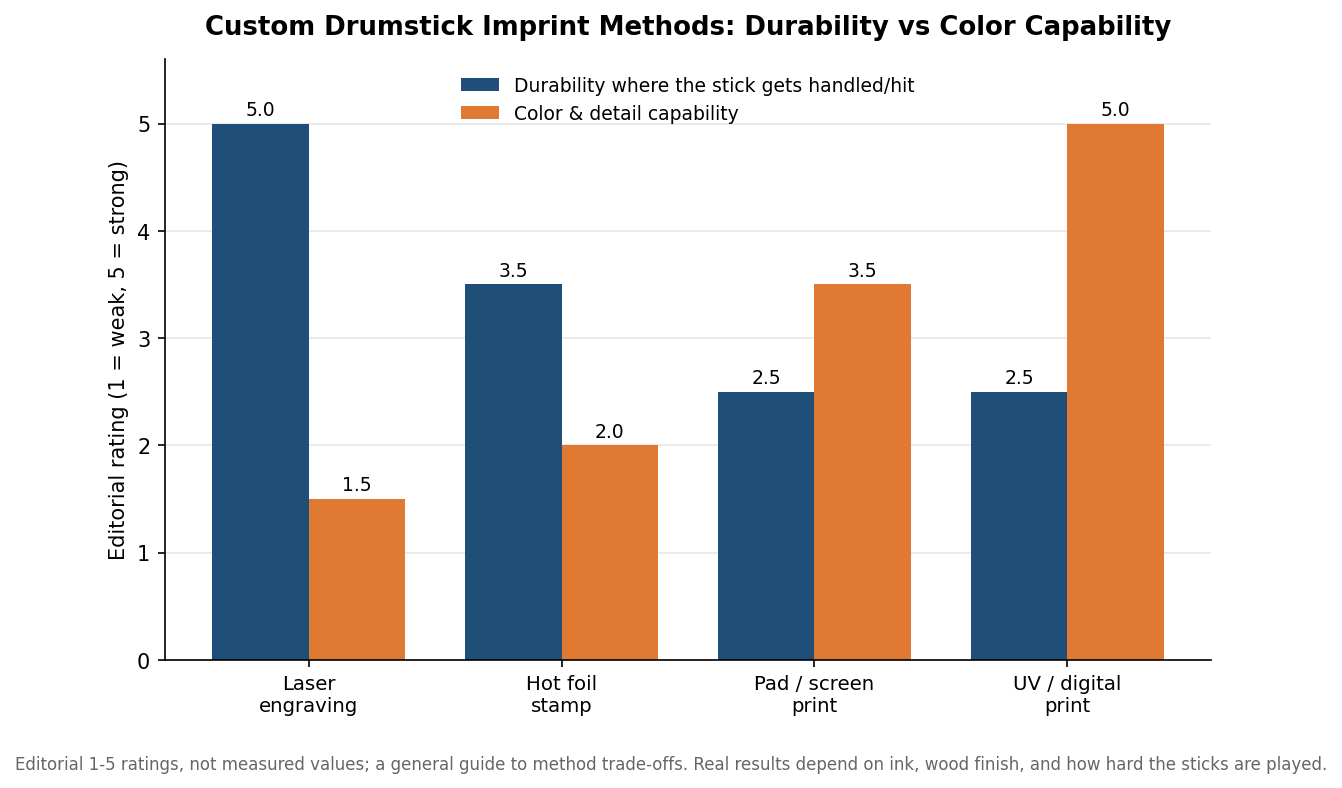
    Grouped bar chart rating four drumstick imprint methods on durability under handling and on color capability: laser engraving scores highest on durability and lowest on color, while UV/digital scores highest on color and low on durability
    The core trade-off: the methods that hold color best wear fastest, and the method that never wears holds no color.

    The chart above is a general guide rather than a lab result, but it captures the core tension every buyer faces. The two methods that hold color best are the two that wear fastest under real playing, and the method that never wears cannot hold color at all. Where your order lands depends entirely on whether the sticks are instruments or souvenirs.

    Hot foil and UV: the specialty options

    Hot foil stamping uses heat and a metal plate to press a metallic or reflective film onto the surface, giving you a shiny gold, silver, or colored-foil mark that looks a cut above flat ink. It is more durable than plain ink and visually distinctive, but you are limited to one foil per pass, setup takes time, and the per-unit cost sits above pad printing. It shines for anniversary sticks, commemorative runs, and premium retail packaging where the metallic finish justifies itself. UV or digital printing sits at the opposite corner: it jets a full-color image directly onto the stick with effectively unlimited colors and photographic detail, so it is the only method that reproduces a gradient, a photo, or a complex multicolor logo faithfully in a single operation. Its weakness is that a printed film on a flexing, impact-loaded stick can chip or scuff over heavy use, so it behaves more like pad printing than like engraving on the durability axis. Reach for it when the artwork simply cannot be reduced to a few spot colors.
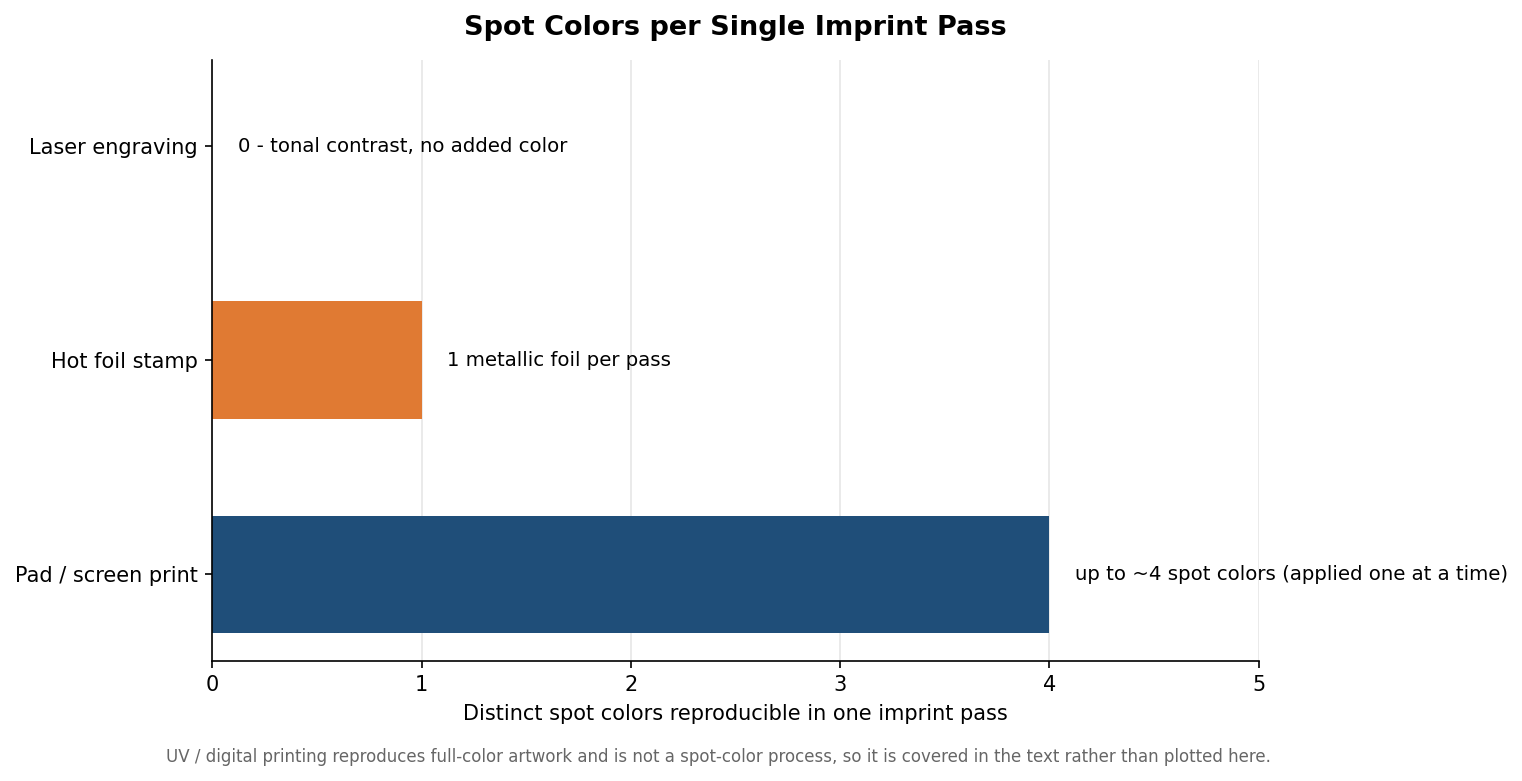
    Horizontal bar chart of spot colors reproducible in a single imprint pass: laser engraving 0 tonal, hot foil 1 metallic, pad or screen print up to 4 spot colors
    Spot-color capacity per pass for the three spot methods; UV/digital handles full color and is discussed in the text.

    The spot-color chart makes the practical limit explicit. If your design is one or two flat colors, any of the spot methods can carry it. The moment you need a third and fourth color, pad printing starts adding passes and cost, and once you cross into gradients or photographic art, you have effectively chosen UV whether you meant to or not, because it is the only process built for it.

    Matching the method to your order

    The decision usually resolves along two questions. First, will these sticks be played or displayed? Sticks that get used hard argue for engraving, where wear is a non-issue, while sticks destined for hands in a crowd can take the more colorful, less durable ink methods without anyone noticing the eventual fade. Second, how much color does the design truly require? A single-color wordmark opens every door and lets cost decide; a multicolor or photographic design closes most of them and points at UV. Budget and quantity then fine-tune the answer, since setup-heavy methods like foil and engraving reward larger runs while pad printing stays cheap even at modest volumes. None of these is the best method in the abstract. The best method is the one whose strengths line up with how your particular sticks will be used, and the fastest way to a result you are happy with is to tell your supplier that use case up front rather than just sending a logo and hoping.
  • Choosing Drumsticks by Sound: Wood Species and Tip Shape

    Choosing Drumsticks by Sound: Wood Species and Tip Shape

    Most drummers pick a stick by the number printed on it and stop there. But two choices that never appear in a model name, the wood the stick is turned from and the shape of its tip, do more to determine how you sound than 5A versus 5B ever will. Get those two right for the music you actually play and a stick stops being a compromise and starts feeling like part of the kit.

    This is a guide to choosing by sound rather than by habit. Wood species sets the weight and feel in your hand; tip shape and material set what the cymbals and drums give back. Neither is a matter of better or worse, only of fit, and the fit depends entirely on the room, the volume, and the style you are playing.

    Wood species sets the feel in your hand

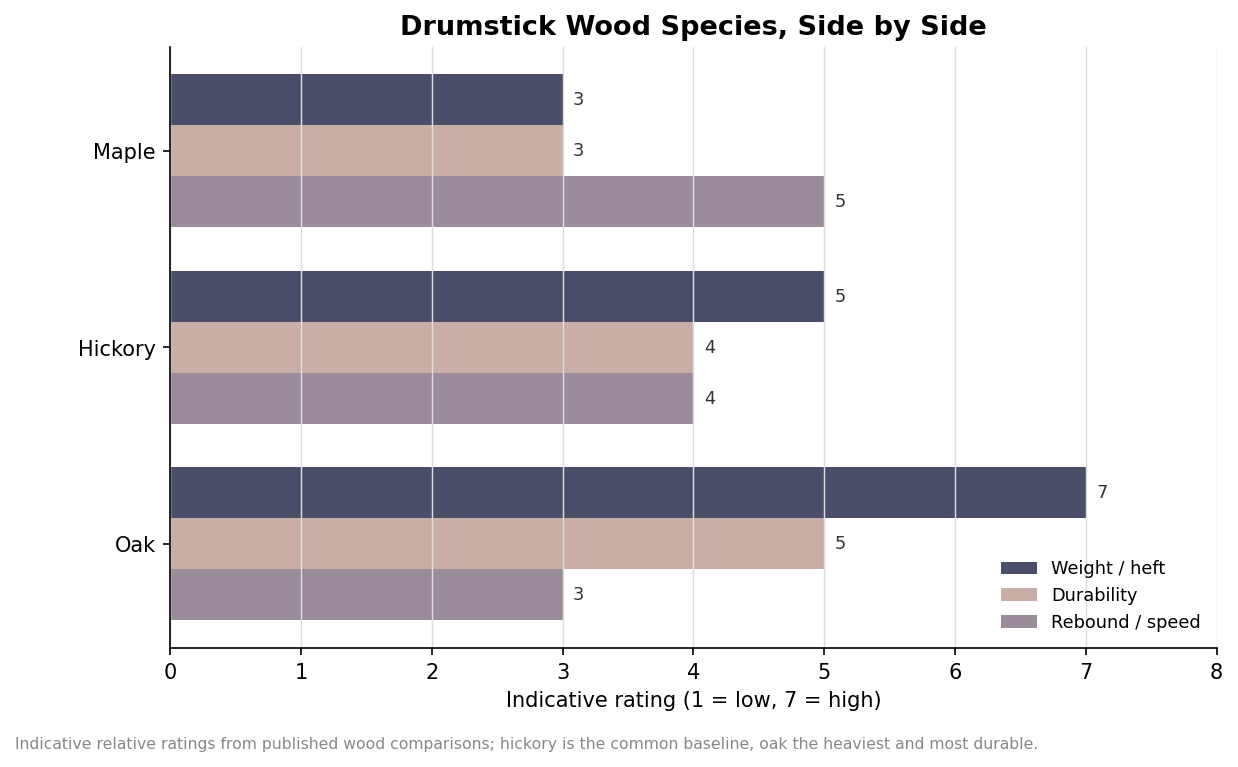
    Three woods cover nearly every stick on the wall, and they are genuinely different tools. Hickory is the baseline for a reason: it is dense enough to be durable, it absorbs shock well so it is comfortable through a long set, and it sits in the middle for weight and response. If you do not have a specific reason to choose otherwise, hickory is the safe default that most players never need to leave.

    Maple is the lightweight. It is less dense than hickory, which makes it noticeably lighter and faster in the hand and gives it a softer, warmer voice on the kit. Players who want speed, finesse, and control at lower volumes, or who simply find heavier sticks tiring, gravitate to maple. The trade is durability: a lighter, softer wood does not survive rimshots and hard backbeats as long as the alternatives.

    Oak is the tank. It is the densest of the common woods, which makes it the heaviest and the most durable, and it delivers a louder, more forceful sound with less flex. For a hard-hitting player or a loud stage, oak’s longevity and power are the point; the cost is that the extra weight asks more of your wrists over a long night. Read the three side by side and the pattern is simple: as you move from maple to hickory to oak, you trade speed and comfort for weight, power, and stick life.

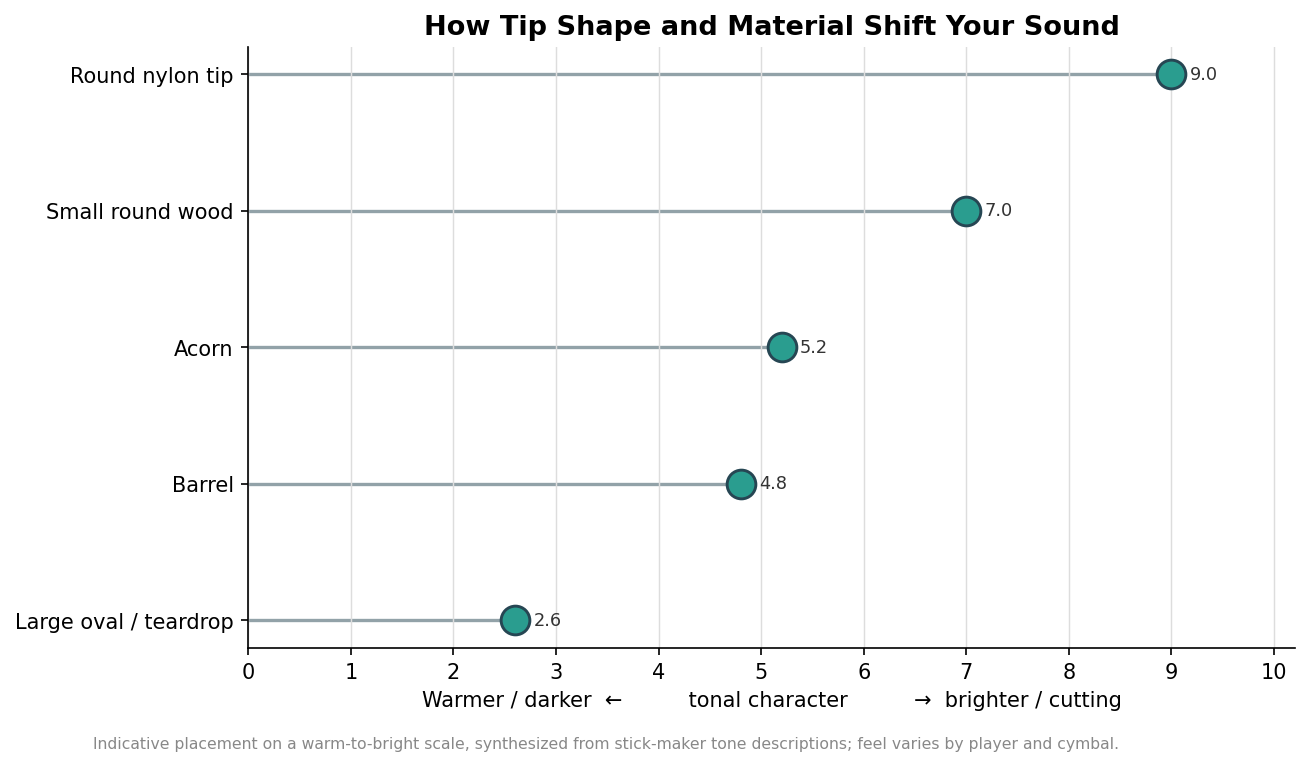
    Dot plot placing round, barrel, acorn and oval drumstick tips on a warm-to-bright tonal scale
    Tip shape and material move your sound along a warm-to-bright spectrum.

    The tip shape decides your cymbal sound

    If wood is what your hand feels, the tip is what the microphone hears. The shape controls how much of the tip actually contacts a cymbal or head, and that contact area is what sets the tone. Round and ball tips touch the smallest area, so they produce the brightest, most articulate, most consistent sound; small round tips are a jazz and funk favorite for their clarity and bounce, while larger round tips fatten that sound up for rock. At the other end, large oval and teardrop tips spread the contact over more surface, pulling out darker, warmer, fuller tones with a rich low end and softer articulation.

    In between sit the workhorses. Barrel tips put a lot of surface on the cymbal for a punchy, loud, full sound that cuts through a live band. Acorn tips aim for the best of both, a full, defined response on cymbals with clear articulation on the drums. None of these is objectively better; they are points on a spectrum from bright and cutting to warm and broad, and the right one depends on whether you need to slice through a loud stage or blend into a quiet room.

    Wood tip or nylon tip

    The tip’s material is a smaller decision than its shape, but a real one, and it mostly comes down to cymbals. Wood tips give a warmer, rounder cymbal sound and a softer attack, and many drummers simply prefer how they feel and rebound; the drawback is that wood wears down with use, and as the tip changes shape its cymbal sound drifts with it. Nylon tips sound distinctly sharper and brighter on cymbals, project harder, and, because they hold their shape, stay consistent far longer than wood. If you want a bright, cutting ride sound that stays the same for the life of the stick, nylon earns its place; if you want warmth and do not mind that the tone evolves as the tip wears, wood is the classic choice.

    Matching sticks to what you actually play

    Put the pieces together around the music rather than the label. For jazz, light funk, and quiet or acoustic settings, a lighter maple or hickory stick with a small round wood tip gives you the speed, sensitivity, and clear cymbal definition those styles live on. For rock, pop, and general gigging, standard hickory with a barrel or acorn tip is the versatile middle that handles a backbeat and a ride pattern equally well, which is exactly why it is the most common combination sold.

    For loud, aggressive playing, metal, hard rock, or a high-volume stage, an oak stick with a bigger tip and, often, nylon for cymbal cut and durability will outlast and out-project the alternatives. And if you play across styles, the honest answer is that there is no single perfect stick; many working drummers keep two or three pairs and match the stick to the gig the way they would match a snare or a cymbal. The point of understanding wood and tip is not to find one right answer but to make that choice deliberately, so the stick is helping you sound the way you mean to rather than quietly working against you.

    Bar chart comparing maple, hickory and oak drumsticks on weight, durability and rebound speed
    Moving from maple to oak trades speed and comfort for weight, power, and durability.

    When you order custom sticks in bulk, these two variables are exactly where to spend your attention, because they are locked in at manufacture and cannot be adjusted later the way grip or length can. Decide the wood for the feel and durability you need, decide the tip shape and material for the sound you want back from the kit, and the model number becomes what it always should have been: a convenient label on a stick you chose on purpose.

  • Why Drumsticks Always Break in the Same Place

    Ask ten drummers where sticks break and ten will say the shoulder. There is a reason, and it is decided before the stick is turned.

    Grain runout

    Wood fibres run the length of a stick. If they exit through the side, that is runout.

    Load concentrates there, and the stick snaps at the runout rather than at the thinnest point.

    Why species is secondary

    Oak with runout breaks. Straight-grained maple can outlast poorly selected hickory.

    Selection is a sorting cost at the mill, not an exotic material.

    What rim shots do

    The shoulder is the contact point on a rim shot, so wear and load meet at the same place.

    Rotating sticks in practice spreads that wear, which genuinely helps.

    What to ask for

    Straight close continuous grain, selected. And pairs matched by weight and by pitch.

  • Why 5A Is Not a Size

    Every drummer knows their model. Very few know that the model means something different depending on who made it.

    Where the names came from

    Historical factory model numbers, kept because players learned them.

    No standards body ever defined a diameter or a length for any of them.

    What that means in practice

    Two 5A pairs from different makers can differ measurably in both dimensions.

    So the same name can feel front-heavy in one hand and springy in the other.

    The four numbers instead

    Diameter, length, taper length, tip shape. All four are measurable and quotable.

    Send a pair you already like and they can simply be measured off it.

    What to ask a supplier

    For the numbers, not the name. If they can only offer the name, they are reselling.

  • The Complete Buyer’s Guide to Custom Drumsticks

    Sticks are bought by model name and judged by feel, and the two are connected by numbers that almost nobody is given.

    Diameter and length

    These set the mass in the hand and the reach. State them in inches.

    A model name does not: 5A is not a standard and differs between makers.

    Taper length

    The number you feel and cannot name. Long taper: springy, fast, back-weighted.

    Short taper: stiff, front-heavy, powerful. Same diameter, different stick.

    Tip shape

    Round for a focused cymbal ping, barrel for breadth, teardrop and acorn in between.

    Nylon holds its shape, so the sound does not drift as the tip wears.

    Wood

    Hickory damps shock. Maple is lighter and faster and lasts less. Oak is hardest.

    Choose it against how hard you actually play, not against a price.

    And ask about the grain

    Straight continuous grain is the biggest predictor of stick life. Ask if it is selected.