A letter and a number is not a specification.
Get Custom Drumsticks makes hickory, maple and Japanese oak sticks, nylon tips, laser-engraved promo runs and marching specifications — quoted by diameter, length, taper and tip, and matched in pairs by weight and by pitch.
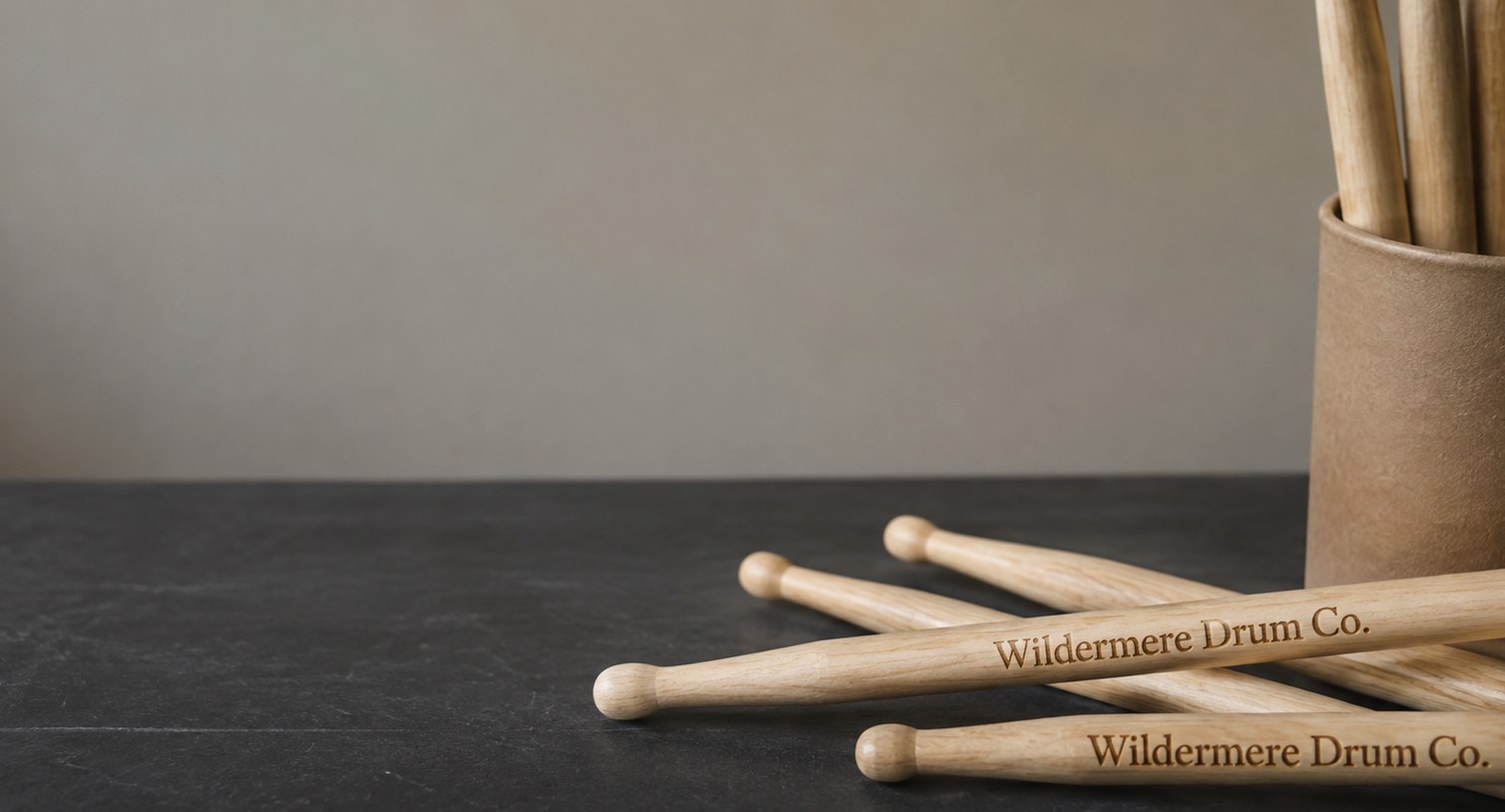
Almost every drumstick in the world is sold as a model name. 5A, 7A, 5B. Drummers say them like sizes, and shops sell them like sizes.
There is no standard behind any of them. A 5A from one factory and a 5A from another differ measurably in diameter and in length, which is exactly why a drummer who plays 5A can pick up a 5A and hate it.
What actually decides how a stick feels is four numbers and a piece of wood selection, and none of the five is printed on the packet.
Why we exist
Four numbers decide the feel of a stick — diameter, length, taper length and tip shape — and one selection decision decides how long it lasts. None of them appears on a normal order form.
All of them are settled before anything is turned, and none of them is expensive.
The taper is the thing nobody names
Diameter and length set the mass. Taper length sets the balance and the rebound, and it is the number people feel and cannot articulate.
A long taper moves weight back toward the hand: springier, faster, more finesse. A short taper leaves the stick front-heavy and stiff: more power, less nuance. Two sticks with identical diameter and length can play completely differently because of it.
Grain beats species
Hickory damps shock, maple is light and flexible, oak is hard and unforgiving. All true, and all secondary.
A stick breaks where the grain runs out of the shaft, usually through the shoulder, and it will do that whatever wood it is made of. Straight, close, continuous grain running the full length is the single biggest predictor of how long a pair lasts, so that is what we select for.
Pairs are matched by pitch, not just weight
Two sticks that weigh the same can differ in stiffness, and stiffness is what you hear when you tap them: a matched pair rings at the same frequency.
A pair mismatched that way feels wrong long before anybody can say why, and across a marching line of twelve players it stops sounding like one line at all.
The mark has to survive the hand
A pad-printed logo on the shaft sits exactly where the hand closes, and it is a ghost within weeks of real playing.
A laser engrave removes material rather than adding a layer, so nothing is left to rub off. It does very slightly raise the grain, which some players like as grip — we say so rather than letting anybody be surprised — and on sticks that will be played we place the mark toward the butt, out of the grip zone.
What we will talk you out of
Maple for a marching program. Oak in the same numbers as your hickory. Nylon tips on a line that drops sticks on tarmac. A big printed logo down the shaft of a stick that is going to be played.
And any promise that a stick will not break. A drumstick is a consumable and it is meant to break eventually. We also sell no drums, hardware, heads, cymbals, pads, cases, brushes, rods or mallets, and nothing here is a toy or a child’s product.
How we work
ASK
What you play now, how hard, and whether these get played or handed out.
SPEC
Diameter, length, taper length, tip shape, wood and finish.
MATCH
Pairs matched by weight AND by pitch.
MOCK
Free mockup within 24 hours.
SHIP
About 2 weeks, with the real date confirmed before you commit.
Who we serve
Get in touch
Text or call George at (929) 605-4397, or email info@getcustomdrumsticks.com. Free mockups, low minimums, and a lowest-price guarantee.
Win Free Stuff
Enter below for a chance to win plus receive 10% off your first order.
🎉 You are in!
We will text you your 10% off code. Good luck!