When people order custom drumsticks in any quantity, most of the attention goes to the stick itself, the wood, the size, the tip. The decoration is treated as an afterthought, and that is exactly where orders go sideways. The imprint method decides whether your logo survives a season of playing or rubs off in a week, whether you can run full color or a single line, and a fair amount of what the job costs. There are four methods you will realistically be offered, and they are genuinely different tools rather than interchangeable options. Here is how they compare and when each one is the right call.
Laser engraving: permanent, but no color
Laser engraving burns the design into the wood, converting light into heat and removing a thin layer of surface to reveal a darker, contrasting mark. Because the artwork is physically part of the stick rather than sitting on top of it, it cannot rub, chip, or wash off, which makes it the most durable option by a wide margin, precisely in the zone where a drummer’s hands and the rim take the most punishment. The trade-off is color: engraving produces a tonal, monochrome mark and cannot add a single drop of ink. If your identity depends on a specific brand color or a full-color crest, engraving will not carry it. It also tends to cost more than ink methods and, on lighter woods like maple, the contrast can be subtler than on darker hickory. Choose it when longevity beats color, for pro-level sticks, retail lines meant to last, or anything where a worn logo would look cheap.
Pad and screen printing: color on a budget
Pad printing, the workhorse behind most inexpensive promotional sticks, presses a silicone pad loaded with ink onto the surface, and can lay down up to about four spot colors, though each color is applied in a separate pass rather than all at once. It produces clean, crisp images at a low unit cost, which is why it dominates giveaway and event runs. The catch is durability: the design is ink sitting on the wood, and the section of a stick that lands in your palm and strikes the drum is the section that wears first. For sticks that will actually be played hard, expect the print to fade over time. For sticks that are handed out, waved, signed, and kept as keepsakes, that wear rarely matters and the color and price win.
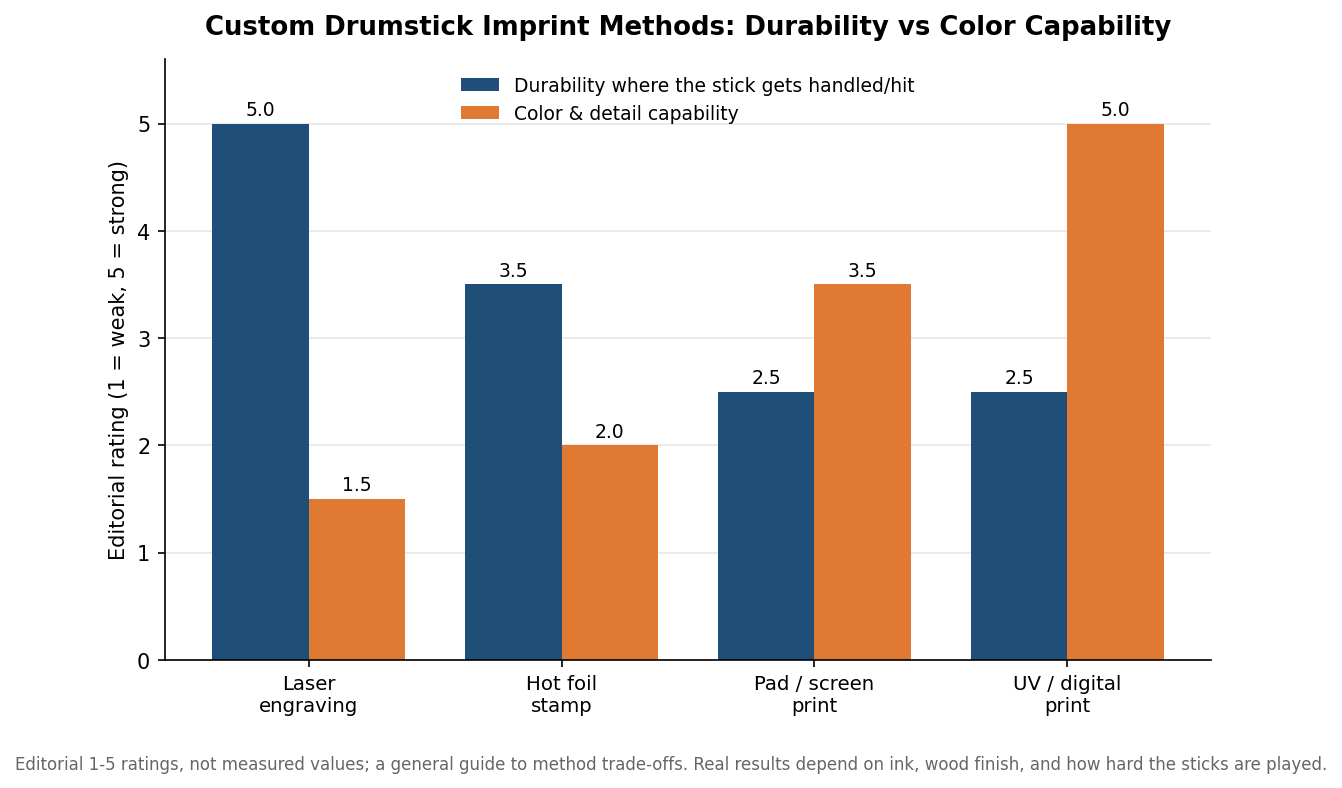
The chart above is a general guide rather than a lab result, but it captures the core tension every buyer faces. The two methods that hold color best are the two that wear fastest under real playing, and the method that never wears cannot hold color at all. Where your order lands depends entirely on whether the sticks are instruments or souvenirs.
Hot foil and UV: the specialty options
Hot foil stamping uses heat and a metal plate to press a metallic or reflective film onto the surface, giving you a shiny gold, silver, or colored-foil mark that looks a cut above flat ink. It is more durable than plain ink and visually distinctive, but you are limited to one foil per pass, setup takes time, and the per-unit cost sits above pad printing. It shines for anniversary sticks, commemorative runs, and premium retail packaging where the metallic finish justifies itself. UV or digital printing sits at the opposite corner: it jets a full-color image directly onto the stick with effectively unlimited colors and photographic detail, so it is the only method that reproduces a gradient, a photo, or a complex multicolor logo faithfully in a single operation. Its weakness is that a printed film on a flexing, impact-loaded stick can chip or scuff over heavy use, so it behaves more like pad printing than like engraving on the durability axis. Reach for it when the artwork simply cannot be reduced to a few spot colors.
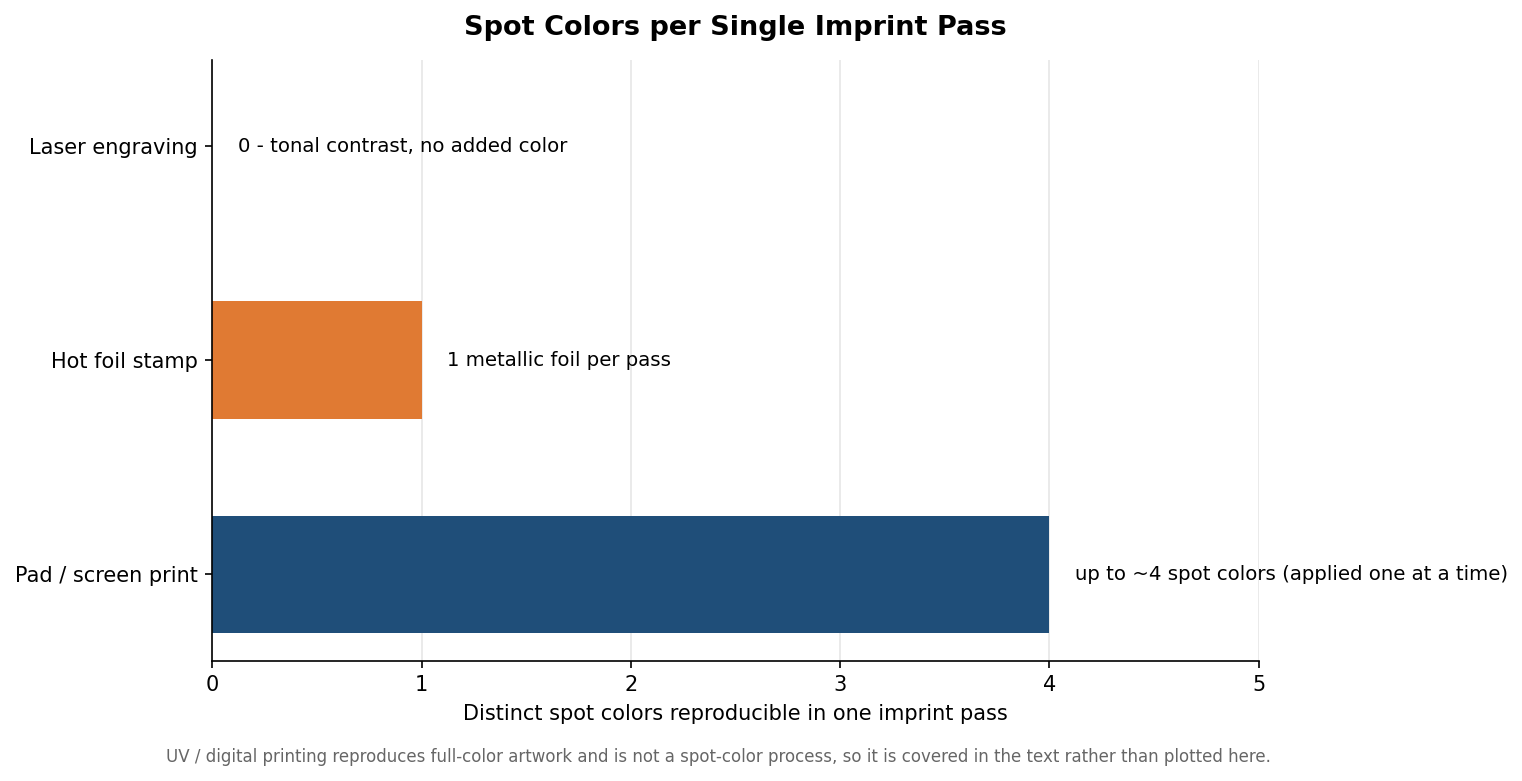
The spot-color chart makes the practical limit explicit. If your design is one or two flat colors, any of the spot methods can carry it. The moment you need a third and fourth color, pad printing starts adding passes and cost, and once you cross into gradients or photographic art, you have effectively chosen UV whether you meant to or not, because it is the only process built for it.
Matching the method to your order
The decision usually resolves along two questions. First, will these sticks be played or displayed? Sticks that get used hard argue for engraving, where wear is a non-issue, while sticks destined for hands in a crowd can take the more colorful, less durable ink methods without anyone noticing the eventual fade. Second, how much color does the design truly require? A single-color wordmark opens every door and lets cost decide; a multicolor or photographic design closes most of them and points at UV. Budget and quantity then fine-tune the answer, since setup-heavy methods like foil and engraving reward larger runs while pad printing stays cheap even at modest volumes. None of these is the best method in the abstract. The best method is the one whose strengths line up with how your particular sticks will be used, and the fastest way to a result you are happy with is to tell your supplier that use case up front rather than just sending a logo and hoping.